Frequently Asked Questions About Urinary Incontinence
- What is urinary incontinence?
- What are the different types of urinary incontinence?
- How is urinary incontinence diagnosed?
- What nonsurgical treatments are available for urinary incontinence?
- What surgical treatments are available for urinary incontinence?
- What types of urinary incontinence do men experience? What causes it?
- What urinary incontinence treatments are available for men?
Q. What is urinary incontinence?
A. Urinary incontinence, the most common pelvic floor disorder, is the involuntary loss of urine. Its severity varies from person to person. Some may "leak" a few drops of urine when they cough. Others may feel strong, sudden urges to urinate that can’t be controlled. Others may lose some urine during sexual activity. All of these types of urinary incontinence can be very stressful. Fortunately, they can be treated.
Back to Top
Q. What are the different types of urinary incontinence?
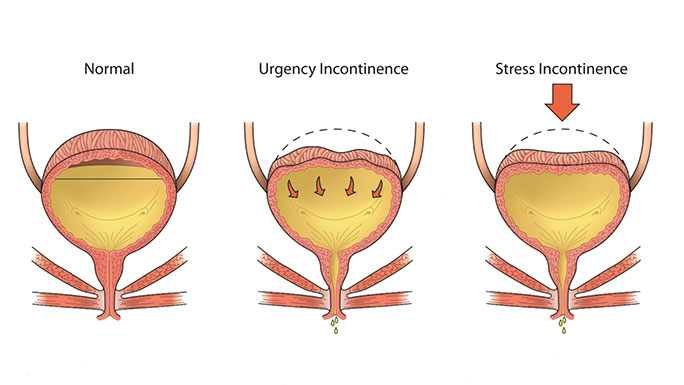
A. There are three main types:
- Stress incontinence: If you leak urine with laughing, sneezing, coughing or exercise, you may have stress incontinence. Stress incontinence is caused by weakness in the muscles and ligaments that support the bladder and urethra. This results in urine leakage with any "stress" or movement that puts pressure on the bladder. Obesity also puts increased pressure on the bladder, which may cause stress incontinence.
- Overactive bladder and urge incontinence: If you go to the bathroom frequently, wake up at night to urinate, feel strong urges to urinate or cannot get to the toilet in time, you may have overactive bladder and urge incontinence. These conditions occur when nerves along the pathway from the bladder to the brain are damaged, causing a sudden bladder contraction that cannot be consciously controlled. Urge incontinence is a common symptom of overactive bladder.
- Mixed incontinence: If you have symptoms of both stress and urge incontinence, then you may have mixed incontinence. For example, you may experience urine leakage during exercise and also when you feel a strong urge. Mixed incontinence is very common. Symptoms of one type of incontinence may be more severe than the other. Treatment may include a combination of therapies for either urgency or stress incontinence and will depend on which symptoms are more bothersome to you.
Back to Top
Q. How is urinary incontinence diagnosed?
A. You’ll need to schedule an appointment with a physician, such as a urogynecologist or a urologist. These specialists are experts in diagnosing and treating incontinence.
The physician will ask you questions, such as how often you empty your bladder, when you leak urine and how much urine you leak. The physician also will complete a physical exam to check for signs of health problems that could cause your problem. Your physician also may order tests, such as:
- Urinalysis to test for signs of infection
- Ultrasound, which uses sound waves to provide a picture of the bladder, kidneys and urethra
- Cystoscopy, a procedure to look at your urethra and bladder using a tiny camera
- Urodynamics, a series of tests to provide information about the function of bladder and urinary muscles
Based on your medical history, exam and test results, your physician usually can determine the cause of urinary incontinence.
Back to Top
Q. What nonsurgical treatments are available for urinary incontinence?
A. Urge incontinence is usually treated without surgery. A combination of therapies is often most effective. This may include behavioral changes, such as urinating on schedule rather than on demand and curbing fluid intake to prevent periods of incontinence. Treatment also may include physical therapy, biofeedback to help you learn to control your pelvic floor muscles and medication that can reduce bladder spasms that create the "urge." Nerve stimulation may be another option for some people with urge incontinence. In addition, some women with bladder spasms may benefit from Botox® injections into the bladder. These help relax the bladder muscles and relieve symptoms of urgency.
If you have stress incontinence, your physician will likely recommend pelvic muscle exercises, also known as Kegel exercises, biofeedback and medication. A device called a pessary is another option. A pessary is a stiff ring that the physician or nurse inserts into the vagina. This helps reposition the urethra to help reduce stress incontinence.
Another option for some women is a minor procedure during which the physician injects a substance into the wall of the urethra to “bulk it up” to help reduce leakage. During this procedure, the doctor inserts a thin tube called a cystoscope into the urethra and injects collagen or a similar substance into the tissue around the urethra.
While these treatments can help many women, those with more serious cases of stress incontinence usually need surgery. Often, these procedures are minimally invasive and allow patients to go home the same day.
Back to Top
Q. What surgical treatments are available for urinary incontinence?
A. There are many different types of surgeries that can relieve urinary incontinence. The surgery your physician recommends will depend on your symptoms.
One of the most common surgeries for stress incontinence is the placement of a "sling" under the urethra. During this minimally invasive outpatient procedure, the surgeon inserts a strip of lightweight mesh under the urethra through a small incision in the vagina. The mesh helps the urethra remain closed when appropriate, preventing involuntary urine leakage.
Penelope Kausal experienced urinary incontinence for many years. After having suburethral sling surgery at the University of Chicago, she has a new lease on life and is more active. » Read Kausal's story At the University of Chicago Center for Pelvic Health, our surgeons are skilled in the use of both biologic (using your own tissue) and synthetic slings. We also offer an adjustable sling, which allows physicians to adjust the tension over time, as needed, using only a local anesthetic.
Another type of surgery for stress incontinence is a bladder neck suspension, which also helps provide support for the urethra and the part of the bladder that connects to the urethra. During this minimally invasive procedure, the surgeon uses a laparoscope to stitch part of the bladder, part of the vagina and the urethra to the bones and tissues in the pelvis. This supports the pelvis and urethra to help reduce leakage.
Back to Top
Q. What types of urinary incontinence do men experience? What causes it?
A. Although women are far more likely to have urinary incontinence than men are because of their anatomy and situations like pregnancy and childbirth, many men also suffer from incontinence.
Although older men are more likely to be affected, incontinence is not a normal part of aging.
Men may experience:
- Stress incontinence, which is the loss of urine during actions that put pressure on the bladder, such as lifting or coughing
- Urge incontinence, which is urine loss following a strong urge to urinate that can’t be controlled
- Overflow incontinence, which involves the constant dribbling of urine
Urinary incontinence in men is often caused by:
- Nerve damage due to stroke, diabetes or other conditions
- Overactive bladder, a condition in which the bladder squeezes at the wrong time
- Prostate issues, including surgery or radiation for prostate cancer
A urologist can diagnose the cause and type of urinary incontinence through a medical history, physical examination and tests. These tests may include:
- Ultrasound, which uses sound waves to create pictures of the bladder, prostate and kidneys
- Urodynamic testing, which checks the bladder’s ability to store and empty urine
Back to Top
Q. What urinary incontinence treatments are available for men?
A. A variety of treatments are available depending on the type of problem, as well as your personal preferences.
Many men are able to regain control by changing their lifestyle and doing exercises to help build their bladder muscles. For others, medicines that slow the production of urine or help manage nerve impulses work well.
For some men with urinary incontinence caused by nerve damage, surgery may be the best option. Some of the common procedures include:
- An artificial sphincter, an implanted device that keeps the urethra closed until men are able to urinate. The device includes a cuff that fits around the urethra, a small balloon inserted in the abdomen and a pump placed in the scrotum. When it is time to urinate, the man squeezes the pump to open up the cuff so that urine moves into the balloon and flows out the urethra.
- A male sling, a surgery that provides extra support for the urethra. The surgeon wraps a strip of material round the urethra and attaches the ends to the pelvic bone. This puts more pressure on the urethra so it doesn’t release urine accidentally.
All of these treatments can significantly improve the quality of life for men faced with the embarrassment and inconvenience of urinary incontinence.
Back to Top
More Information
- FAQ: Pelvic Floor Disorders
- FAQ: Pelvic Organ Prolapse
- FAQ: Urinary Incontinence
- FAQ: Fecal Incontinence